
Why ship a crate rather than another type of packaging?
Choosing crate packaging ensures your goods are well protected throughout the shipment. Unlike a cardboard box, which offers little resistance to rain and impacts, a crate provides far greater rigidity and strength. Crates are therefore particularly recommended when you need to ship heavy, fragile or expensive goods. However, transporting goods in a crate means a double cost: the price of the crate itself, and the extra transport cost caused by the weight and bulk of the crate, which will inevitably be higher than for more basic cardboard packaging.
How do you receive transport rates for your crate shipments?
Devis Transport lets you send one or more crates! Simply fill in the quote request form and you will receive transport rate offers for your crate shipments directly by email. You will have a key choice to make: the type of transport. If it is transport within Europe, it is simple: road transport is what you need.
If, on the other hand, you want to ship a crate internationally, you will have to choose between air freight and groupage sea freight (in technical jargon, this is called shared cargo or LCL). You therefore have the choice between very fast but very expensive transport and, at the other end of the scale, cheap but very slow transport. If you want transport rates for shipping a crate of high-tech equipment to a customer in a hurry, air freight is what you need. On the other hand, if you want to ship a crate of clothes to your mother-in-law, opt for sea freight.
How much does it cost to transport a crate?
The shipping rate for a crate depends on:
- The weight and dimensions of the crate.
- The distance to be covered and/or the country where the crate is to be delivered.
- The type of service required: express transport (sometimes by air) will inevitably cost much more than standard economy transport (by truck within Europe or by sea for long-haul export).
- Options: for example, if you need a truck with a tail lift to lift the crate at collection or on arrival, or full insurance cover, you will incur additional costs.
Should you put your crate on a pallet?
Yes, if the crate weighs several dozen or hundred kilos and its shape is suitable. Placing your crate(s) on one or more pallet(s) will make the carriers' job easier. Just remember to secure, strap or stretch-wrap your crate onto the pallet. If the crate is smaller than the pallet, centre it carefully. The price of shipping a crate may be lower if the packaging of the goods is carefully prepared. This will also limit the risk of breakage and damage to your freight.
What are the 4 types of crates used for transport?
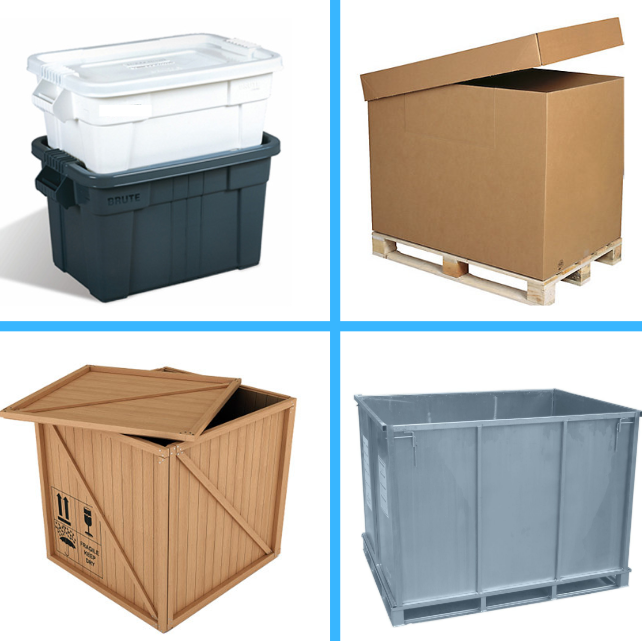
- Wooden crates: this is the most common type of crate for shipping. Wood is strong and makes it easy to build custom crates, ideal for transporting industrial freight or machine tools. Note that for international shipments, the wood must be ISPM 15 treated/fireproofed to obtain export transport approval. Otherwise, the goods could be refused in the country of arrival and the crate returned to you (at your expense, of course).
- Metal crates: less popular, they are nevertheless still used for certain purposes, particularly for export or for transporting various types of equipment. Sometimes made of basic steel, there are also aluminium crates, which are admittedly more expensive but have the advantage of being lighter, making them suitable for air freight, where every extra kilo increases the shipping rate.
- Plastic crates: used for shipments in the food industry or in manufacturing, particularly as reusable returnable crates, plastic crates are easy to handle. Finally, some crates look like large suitcases/trunks and can be used to transport medical, sound and lighting equipment.
- Cardboard crates: yes, there are also crates made of very thick cardboard (at least triple-wall) and crate-pallet units, which make it easier to pack certain goods and for carriers to handle and deliver them.
Which carriers accept crates?
Almost all carriers can transport crates. However, standard parcel carriers (Chronopost, DHL, La Poste, UPS…) may sometimes apply weight limits (30 kg max) or size limits (maximum length under 150 cm, or the sum of the dimensions under 250 cm). As a result, they will only accept "small" crates and may apply "bulky parcel" or "oversized" surcharges, which generally amount to tens of euros. Standard road hauliers (Geodis, Gefco, Dachser, Schenker, XPO) will be able to take your large crates. But if your crate is not placed on a standard pallet, they will have to draw up a tailored quote. In some cases, these crate carriers will need to use a tail lift, or even a crane, to position the crate in the truck.
Crates are also used for international transport by air or by sea, as their strength is an asset in ensuring your goods arrive safely and in good condition. To get quotes for crate transport, fill in our form. It is easy and free!
How do you receive quotes for your crate shipments?
You fill in...
...your transport quote request in two minutes.
We submit...
...your request to carriers.
You receive...
...quotes directly from carriers.